Vintage Halloween Reference Books: Why Collectors Need a Research Library
Vintage Halloween reference books are among the most useful tools a collector can own, yet their value is easy to overlook when attention is focused on the decorations themselves. These books do far more than reproduce pictures of smiling jack-o'-lanterns, eerie paper faces and early party favors. At their best, they help collectors identify objects, investigate age and origins, recognize differences between originals and later copies, understand historical context and make more informed purchasing decisions.
Whether you are new to Halloween collecting, have spent decades building a specialized collection or have inherited a box of unfamiliar decorations, a good reference library gives you a way to move from guesses to evidence. It also preserves the painstaking work of authors, photographers and collectors who have spent years documenting fragile objects that were never intended to survive for generations. Understanding how these books are researched and written makes it easier to choose reliable titles and use them responsibly.
What Is a Vintage Halloween Reference Book?
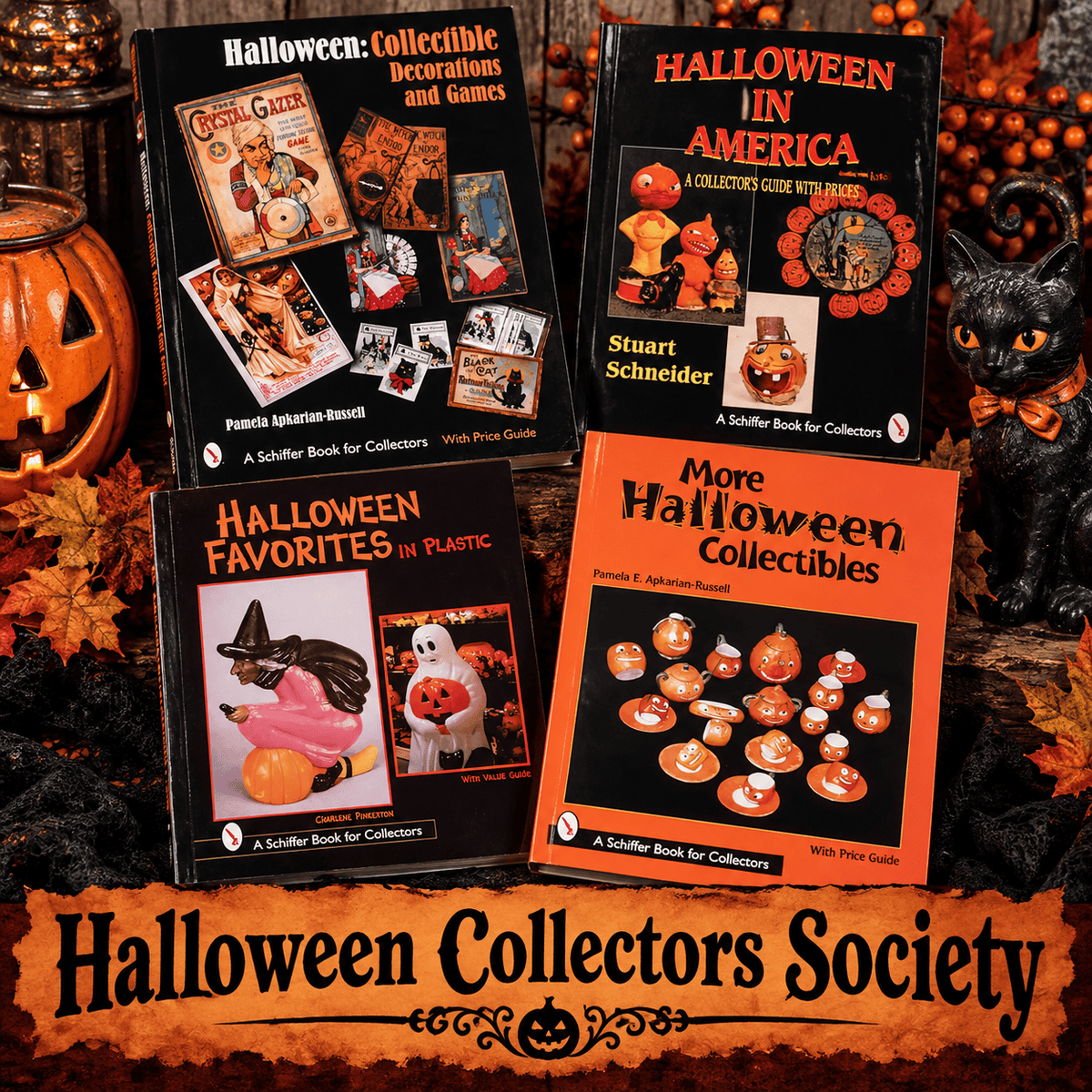
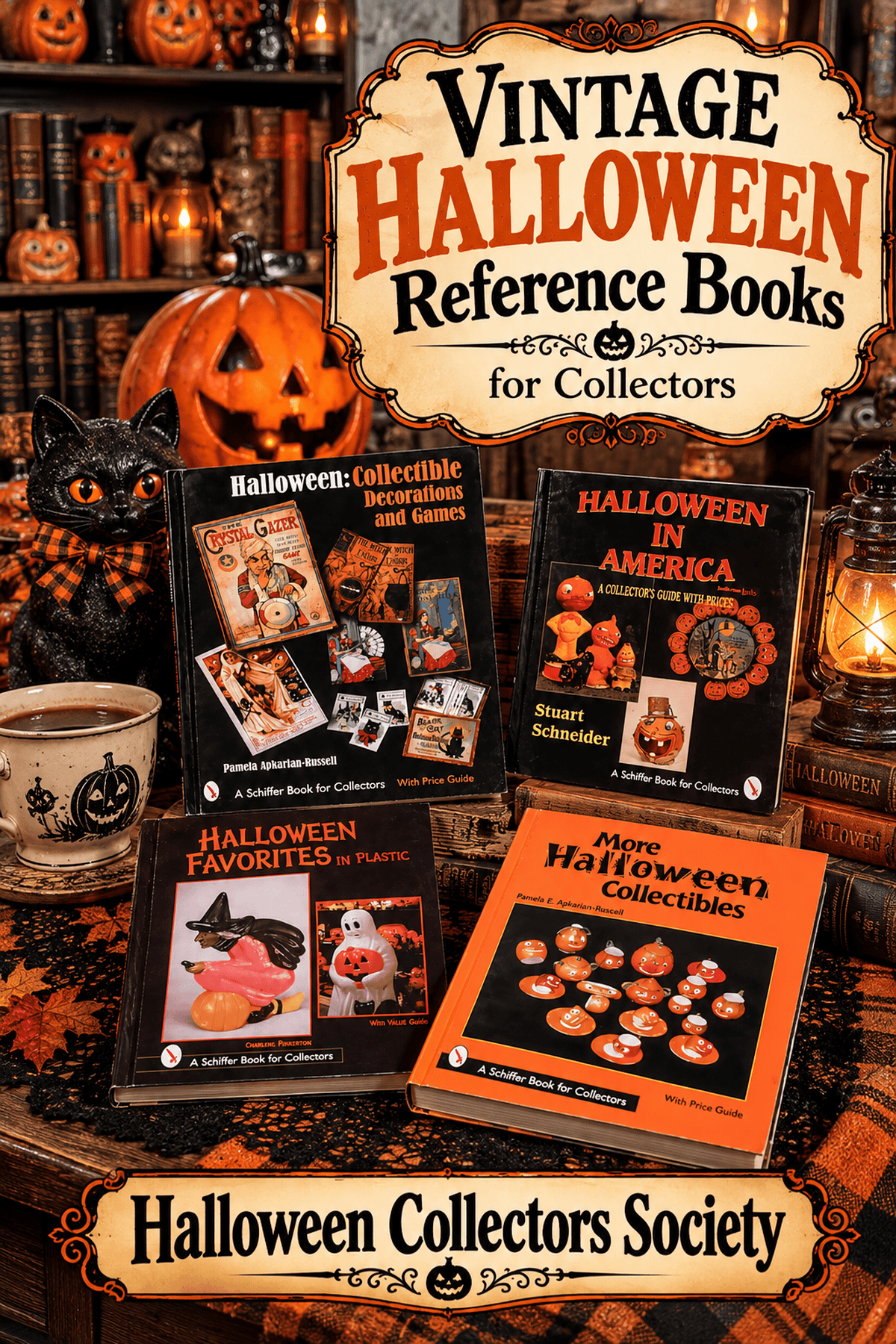
A vintage Halloween reference book is a research tool devoted to identifying, documenting and interpreting Halloween objects from earlier periods. Depending on its scope, it may cover postcards, paper decorations, die-cuts, lanterns, noisemakers, candy containers, costumes, masks, party goods or advertising. A serious reference does more than display attractive photographs. It attempts to connect an object to its manufacturer, approximate production period, materials, construction, original use and place within the history of Halloween collecting. Some books concentrate on a single category; others survey many types of objects to show how holiday design changed over time.
Collectors should distinguish a reference book from a picture book, a price guide and an auction catalog. A picture book may offer inspiration without enough evidence to identify an object. A price guide may include useful identification photographs but its prices can become dated. Auction catalogs document objects offered at a particular time and can preserve valuable provenance, yet their descriptions are not automatically definitive. The most useful collector library combines these kinds of sources and recognizes what each can and cannot establish.
Who Benefits From Keeping Halloween Reference Books?
Beginning collectors benefit because a reference book gives them a vocabulary. Instead of searching vaguely for an old pumpkin decoration, they can learn to describe its material, construction, printing style, shape and likely purpose. That makes it easier to search archives, ask informed questions and compare a potential purchase with documented examples. Experienced collectors benefit in a different way: references help them investigate obscure variations, compare disputed attributions and preserve knowledge that may otherwise disappear when an older collector's personal notes are lost.
Dealers, auction specialists, museum staff, estate-sale shoppers, researchers, historians and families inheriting collections also have reasons to consult these books. A family member sorting an inherited box of decorations may not know which pieces are fragile, which were commercially manufactured and which are later reproductions. A museum volunteer may need to date a display object conservatively without claiming more than the evidence supports. A collector preparing an insurance inventory may need accurate terminology and photographs, although a published price should never substitute for a current professional valuation.
Why a Reference Library Is Worth Building
The greatest advantage of a reference library is the ability to slow down and make a decision using evidence rather than excitement. At an antique show or online auction, a seller may describe a decoration as rare, early or made by a particular company. A book with documented examples can help test that claim by comparing printing, die-cut edges, materials, assembly and known variations. It can also show that similar designs were produced across different years or that a familiar image was reused by multiple manufacturers. The book may not settle the question, but it helps the collector ask better questions before spending money. Consider an unmarked paper jack-o'-lantern decoration described as an early original: before buying, record its measurements, examine the reverse, compare die-cut edges and any embossing, and look for original fastening points or repairs. A published photograph of a similar face is a starting point, not proof that the seller's object is the same issue. A careful buyer compares construction as well as artwork and records any unresolved differences.
Reference books also preserve context that a price tag cannot provide. They can explain how Halloween parties were celebrated, how decorations were marketed, how manufacturing techniques affected appearance and why certain objects survived while others did not. That context turns an assortment of attractive objects into a collection with a story. A library is especially valuable when original packaging, labels or advertising have been separated from the surviving decoration. Historical context does not guarantee a precise attribution, but it gives collectors a more responsible starting point.
What Can a Book Tell You About a Collectible?
A good reference can help identify a collectible's category, compare documented examples and narrow down its likely age or manufacturer. Photographs of the reverse, dimensions, materials and original packaging are especially useful. However, a book cannot authenticate an individual item from a front-view photograph alone, and its published price is not a current appraisal.
How to Use Reference Books When Buying Vintage Halloween
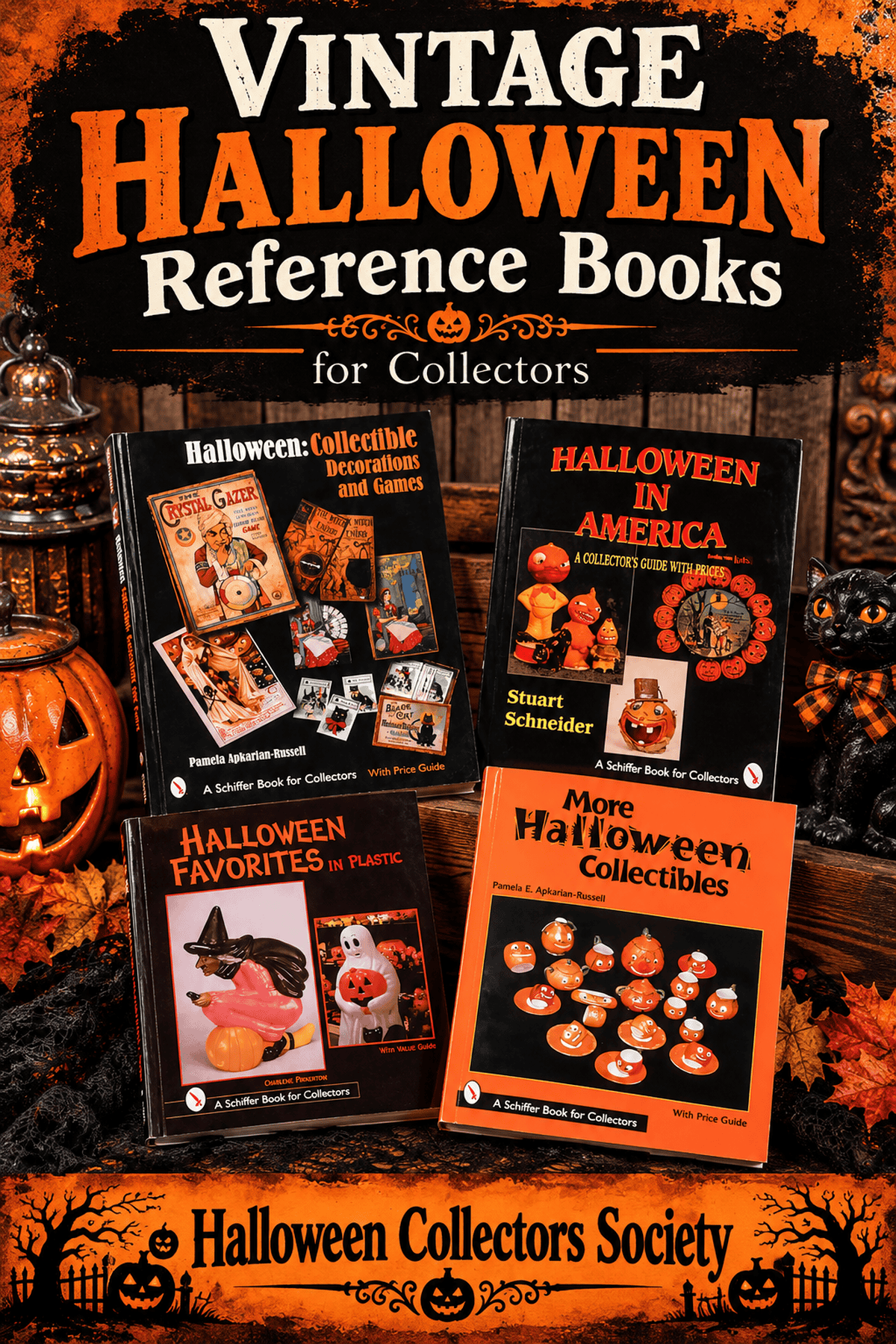
Start with the object itself rather than a seller's description. Record its measurements, materials, colors, printing method, condition and any marks. Photograph the front, back and construction details before comparing it with published examples. If the reference shows a close match, examine the differences as carefully as the similarities. Ask whether the size is consistent, whether the back is finished in the same way and whether the book documents multiple versions. A single similar illustration is a clue, not a certificate of authenticity.
Next, separate identification from value. A book may establish that an object belongs to a recognizable category, but it cannot tell you exactly what that particular example should sell for today. Condition, restoration, completeness, provenance, scarcity and buyer demand all affect current prices. Consult recent comparable sales where possible, and note whether a price is an asking price or a completed transaction. When evidence conflicts, record the uncertainty instead of forcing a confident conclusion. Walking away from a purchase can be the most valuable decision your research helps you make.
The People Who Write These Books
A trustworthy Halloween reference author is usually a researcher first and a writer second. Authors may come from collecting, dealing, archival research, museum work, historical scholarship or long experience studying a particular kind of material. Expertise is not established by a large personal collection alone. It also requires the ability to identify what the surviving evidence does not prove, to question familiar attributions, and to document an object's reverse, construction and context rather than concentrating only on its most photogenic side. It grows through years of handling authentic objects, comparing variations, tracking manufacturers, studying period sources, listening to other specialists and learning to recognize the limits of one's own knowledge. The strongest authors make their evidence visible rather than asking readers to accept an attribution solely on authority.
Producing a reference book often requires cooperation across an entire collecting community. Private collectors may lend objects for photography, families may share catalogs or photographs, and specialists may help identify marks or production methods. An author must decide which claims can be documented, how to distinguish confirmed facts from informed estimates and how to credit contributors. A good book can represent thousands of hours of collecting, travel, correspondence, cataloging and revision. It also requires the humility to acknowledge disputed information and update conclusions when better evidence appears.
What It Takes to Research and Produce a Reference Book
The work begins by defining a manageable subject. A book attempting to document every Halloween object ever produced would be nearly impossible to complete. Authors therefore set boundaries by category, manufacturer, country, material or historical period. They build an inventory of known examples, identify gaps, collect bibliographic sources and create a consistent way to record measurements, marks, condition and provenance. An effective cataloging system matters because photographs and notes become much less useful if the author cannot later connect them to the correct object.
Primary-source research can involve trade catalogs, newspaper advertising, retail circulars, patent records, company documents, dated photographs and surviving packaging. Because Halloween decorations were often inexpensive and intended for brief seasonal use, many surviving examples have lost their packaging, while the advertising and manufacturing records needed to identify them may be scattered across libraries, archives, family collections and private holdings. Newspaper advertisements can document where and when a product was offered; dated photographs can show that a design was already in use; trade catalogs may reveal stock numbers and descriptions. These sources answer different questions and need to be evaluated together. The author then has to reconcile contradictory evidence. An object may have appeared in a catalog in one year but remained in production for several more; a patent date may precede retail availability; and a collector's long-repeated attribution may turn out to have little documentary support. Likewise, the date on a family photograph establishes that an object existed by then, but it cannot by itself prove who manufactured it. Responsible authors distinguish a documented date, a likely production range and an unsupported guess. Careful writers explain those distinctions rather than treating every date as a manufacturing date.
Photography presents another substantial challenge. Fragile paper decorations may not tolerate repeated handling, glossy surfaces produce reflections and faded colors are difficult to reproduce faithfully. Images need consistent scale, clear lighting and sufficient detail for comparison. The author or publisher must obtain appropriate permissions for borrowed photographs and archival material, verify captions, organize an index, proofread names and dates, and design pages that remain useful as references rather than simply attractive spreads. Printing costs can be significant for a specialized, image-heavy book with a relatively small audience.
How to Judge Whether a Reference Book Is Reliable
Look first at the author's experience and the way the book supports its claims. Does it identify sources, explain how objects were dated and distinguish confirmed facts from estimates? Are photographs clear enough to compare details? Are dimensions and materials provided consistently? Does it acknowledge reproductions, altered objects and known variations? An index, bibliography, manufacturer information and informative captions make a reference easier to use repeatedly. A book can still be valuable without every one of these features, but understanding what is missing helps you decide how heavily to rely on it.
Publication date matters, too. An older reference may contain exceptional firsthand knowledge and photographs of objects that are difficult to locate today, while its price estimates and some attributions may have aged. When an edition has been revised, check which photographs, identifications and price information changed, and keep the edition number in your notes so another researcher can locate the same evidence. Newer books can benefit from additional discoveries but are not automatically more accurate. Read reviews and corrections from experienced collectors, compare overlapping entries between references and mark disputed conclusions in your own research notes. No single volume should become the unquestioned authority for an entire collection.
Reference Books, Reproductions and Misidentified Pieces
One of the most practical uses for a reference book is learning the construction details associated with genuine period merchandise. Printed colors, paper texture, embossing, cut edges, staples, crepe-paper attachments, metal hardware and wear patterns can help distinguish objects. However, age alone does not establish originality, and artificial distressing can be misleading. A modern reproduction may copy the front artwork closely while differing on the back, in its materials or in its assembly. Conversely, legitimate period variations can look unusual enough to raise questions.
Use references as one part of a broader authentication process. Compare several examples, examine the actual object when possible, request detailed photographs and ask about provenance. Do not rely on a book photograph to prove that a seller's item is authentic, and do not label an undocumented object a fake merely because it is absent from a familiar guide. HCS members can continue the investigation with the site's training on spotting reproductions, fantasy pieces and misidentified collectibles.
Why Published Price Guides Have Limits
Printed price guides reflect the market and available information at the time they were prepared. Values can change with condition, provenance, rarity and collector demand. Treat the listed figures as historical context, then compare recent completed sales of genuinely comparable objects rather than assuming an old guide establishes today's selling price.
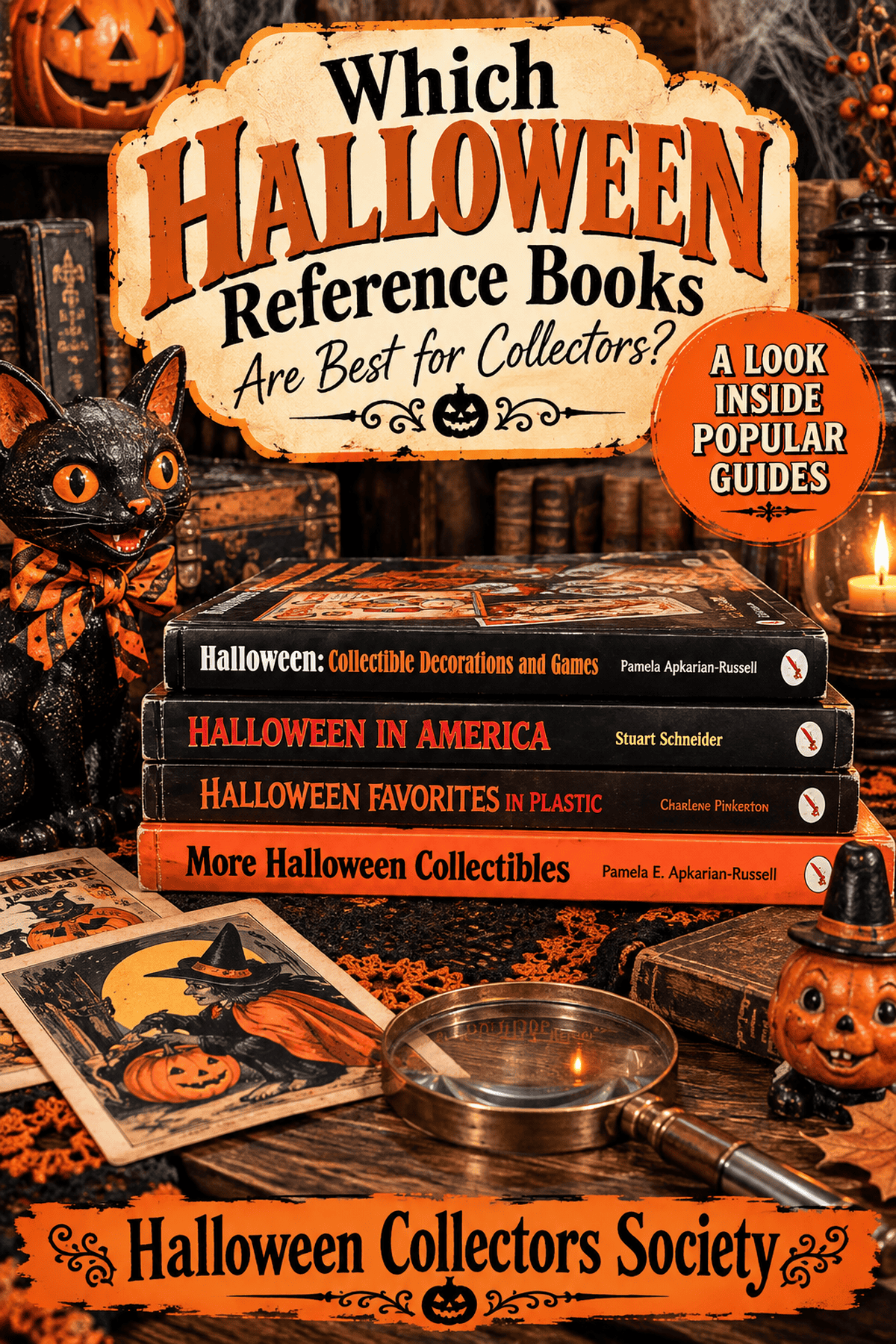
Building a Practical Halloween Research Library
Begin with the objects you actually collect. Someone specializing in postcards needs different coverage from someone researching paper lanterns, costumes or candy containers. A broad overview can establish vocabulary and historical context, followed by one or two specialized books with detailed photographs. Before buying an expensive out-of-print title, examine its table of contents, publication information, image quality and subject coverage. Libraries, collector clubs and reputable secondhand booksellers can help you determine whether the book answers the questions you regularly face.
Keep a simple index of your own. Record the books you own, their editions and publication dates, and which pages document items in your collection. Use removable bookmarks or a separate digital note file rather than writing on valuable books if you want to preserve their condition. Add observations from objects you handle and identify where published sources disagree. Store the books away from dampness, pests and direct sunlight; a research library is itself a collection worth protecting.
How to Document Your Own Collection Using Books
Create a record for each object with a unique inventory number, measurements, photographs, material description, condition notes, acquisition date, seller information and any available provenance. When a reference supports an identification, record the book's author, title, edition, publication year and page number. Quote or summarize the relevant evidence accurately, and separate the author's statement from your own interpretation. If the book identifies a similar but not identical example, say so. This record is more useful to heirs, insurers and future researchers than a label that simply reads 'rare antique Halloween.'
Revisit records when new information appears. A correction may change an estimated production period or reveal that an item was made by a different company. Updating the record does not diminish the collection; it makes the history more accurate. For a structured starting point, HCS offers a member training on building a collector record that will outlive you.
When Should a Collector Consult a Reference?
Research is useful before, during and after a purchase. Before shopping, study the categories that interest you and the characteristics that distinguish documented examples. At an estate sale or antique show, consult photographs and notes without letting a rushed comparison replace a careful inspection. After buying, record your findings while details of the transaction are still fresh. Consult references again when you insure, lend, display, sell or pass on an object, because the documentation needed for each purpose can differ.
Seasonal collecting creates its own pressure: Halloween inventory often attracts attention in late summer and fall, and a seemingly scarce item can provoke an impulse purchase. Maintaining a year-round research habit makes it easier to recognize a promising object without depending on a seller's urgency. Reference books are especially useful in the quieter months when there is time to compare sources, update records and learn unfamiliar categories.
The Larger Legacy of Halloween Reference Authors
A carefully researched reference book does more than assist individual buyers. It preserves evidence of everyday manufacturing, retail culture, illustration, printing and changing attitudes toward Halloween. Many decorations were inexpensive and disposable when first sold; relatively few people thought to preserve their packaging or record the companies that made them. Collectors and authors who document surviving examples help reconstruct that history. Their work may also identify makers whose contributions were previously overlooked or distinguish original commercial products from later reinterpretations.
Reference authors do not work in isolation. Their books are built on objects preserved by collectors, information shared by researchers and questions raised by readers. Future discoveries may correct individual claims, but that is how a healthy field of collecting knowledge develops. A book that encourages careful observation and documentation has lasting value even after some of its conclusions change.
Where to Continue Learning
The Halloween Collectors Society education and collector resources area is a useful starting point for exploring identification, research and preservation topics. Readers who need help with an object that has no maker's mark can also consult the HCS member training on researching an unmarked Halloween collectible. These resources complement reference books by helping collectors turn published information into a repeatable research process.
Ultimately, the best reference book is not necessarily the oldest, most expensive or most beautifully photographed one. It is the volume you return to because it answers specific questions, shows its evidence and teaches you to look more closely. Building a small, dependable research library can help protect both your collecting budget and the history behind the objects you love.


