Apple Paring: The Old Halloween Fortune-Telling Game That Revealed Your Future Mate
I have a weakness for old Halloween traditions - especially the ones that make me stop and think, wait, people really did this at Halloween? Apple Paring started out that way for me. Peel an apple in one long strip, toss the paring and look for a letter. Simple enough. Except once I started following that apple peel through the old sources, the story kept getting better. Suddenly I was reading about young women trying love spells in 1714, Halloween parties with apples roasting at the hearth, guests swinging parings around their heads, riddles tucked inside walnut shells and even fortunes hidden in mashed potatoes. That is when this stopped feeling like one quaint little game and started feeling like a doorway into an almost forgotten kind of Halloween night.
Long before Halloween parties revolved around packaged decorations and bowls of candy, items such as apples, nuts, mirrors, candles, rings and other ordinary household objects were used for Halloween games and fortune-telling. Love and marriage show up again and again in these old amusements. Who would you marry? What would your future sweetheart be like?
And sometimes, apparently, all you needed to answer the question was an apple, a knife and a very steady hand.
How Far Back Does Apple Paring Go?
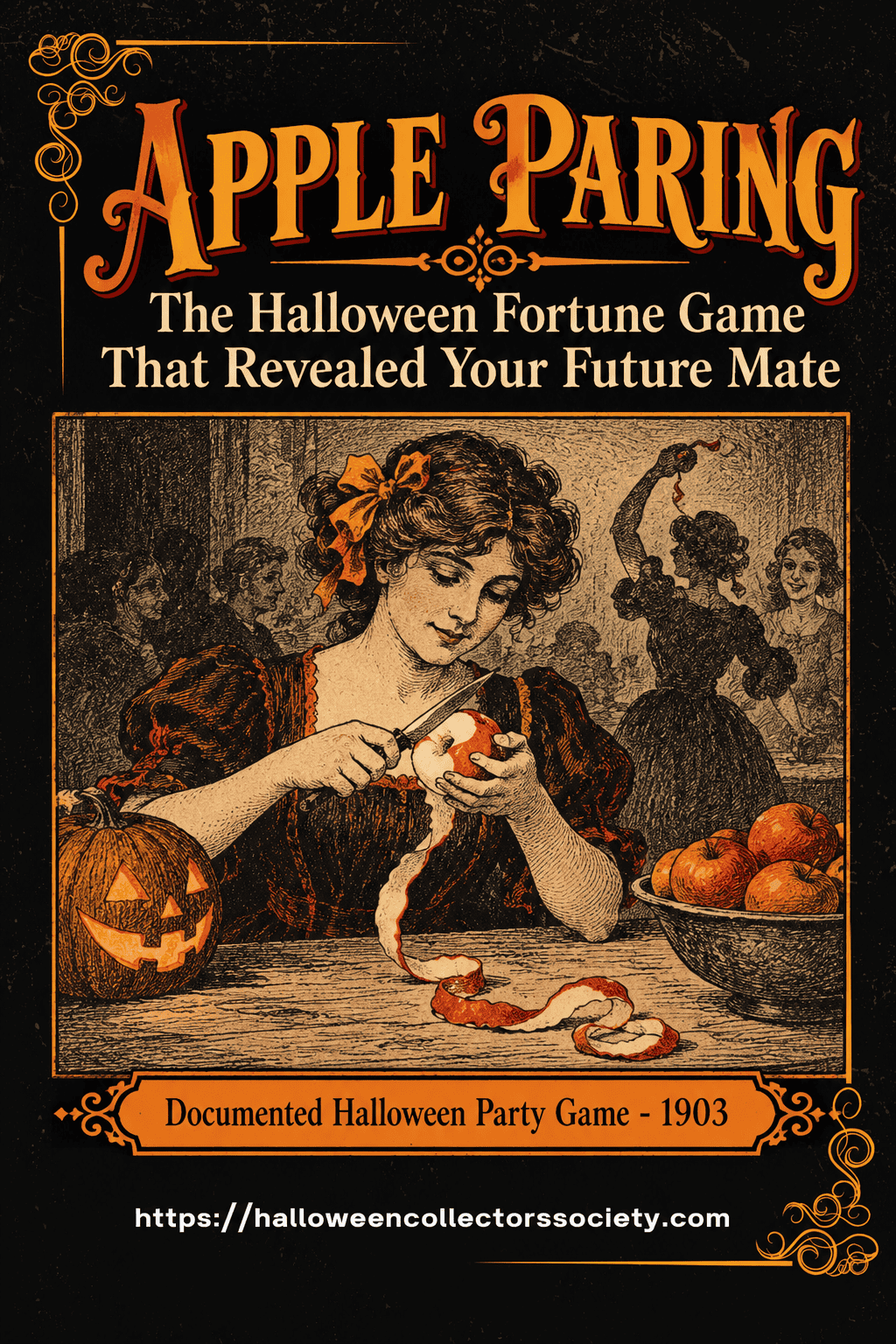
I started with a 1903 Halloween party game. I did not expect the apple peel to take me back almost two centuries.
The earliest evidence found by HCS so far is from 1714. And once I found it, I had to go read what was actually happening rather than simply add another date to a timeline.
In John Gay's The Shepherd's Week, in the pastoral Thursday; or, The Spell, a young woman named Hobnelia pares a pippin in an unbroken strip, throws the paring over her head and reads the shape it makes on the ground as a letter connected with the shepherd she loves. It is unmistakably a closely related apple-paring love divination.
I am deliberately calling 1714 the earliest evidence found by HCS, rather than claiming this is when the custom began. A printed reference tells us that the practice was known by that date. It does not tell us who first invented it, how long people had already been doing it or whether an earlier written account is still waiting to be found.
What happens next is where the trail gets especially good. By the 1890s, the apple paring is no longer something I have to connect to Halloween by inference. Period sources put it there themselves - and they do not all give exactly the same rules.
By 1903, somebody had gone a step further and put it into a Halloween entertainment book as an actual numbered party game. But before we get there, the 1890s deserve their own stop. They give us something I wanted from the beginning of this research - not just the rule, but glimpses of people actually entertaining themselves playing the apple peel game.
A Pippin, an Unbroken Peel and a Perfect L
The 1714 reference deserves more than just a date on a timeline because John Gay actually gives us a scene. In The Shepherd's Week, Hobnelia is worried about Lubberkin, the shepherd she loves. She tries a series of charms and spells, and one of them involves a pippin - which is an apple.
She pares it round and round, keeping the peel unbroken. Then she throws that long paring over her head. When it lands on the grass, she reads the shape as a letter. To Hobnelia's delight, it looks like an L - the first letter of Lubberkin's name.
That is the moment that made me stop. We are looking at the same essential action that appears in the later Halloween game: peel the apple without breaking the paring, throw it over your head, look at the shape it makes and read that shape as the initial of a sweetheart. The 1714 scene is not labeled a Halloween party game, and I do not want to pretend that it is. What it does show is that this form of apple-paring love divination was already recognizable enough to appear in print nearly two centuries before our 1903 game.
There is another detail I love. Hobnelia does not stop with the peel. She takes two seeds from the same apple and uses them in another love test, naming one for Lubberkin and another for a rival. In other words, the apple is not merely food in this scene. Peel and seed both become tools for asking questions about love.
And this is where I have to resist the temptation to make the evidence say more than it does. Gay's poem proves that the idea was in print in 1714. It does not prove Gay invented it, and it does not tell us how many generations of people may have practiced some version of this divination before he wrote it down. That is why our HCS record says earliest evidence found by HCS, not "the game began in 1714." If we eventually find something earlier, our timeline changes. That is what research is supposed to do.
By 1895, the Apple Paring Game Is at Halloween Parties
Now move forward 181 years. In an 1895 issue of Harper's Round Table, a character is asked what people do on Halloween. The answer is wonderfully specific. There is bobbing for apples. Another amusement used a horizontal stick suspended at its center so it could spin. An apple was fixed to one end and a lighted candle to the other. The player tried to catch the moving apple with their teeth as the stick revolved - which also meant the candle kept coming around. The account jokes about being "smutched" in the attempt. In other words, getting marked by the candle or its soot when you missed was part of the comedy, not the object of the game. There is an apple eaten before a looking-glass while holding a candle in hopes of seeing the person one will marry.
And right there among those Halloween customs is our paring. The apple is pared, the peel is thrown over the right shoulder, and the shape is read as the first letter of the name of the man the player will marry.
This matters because now we are no longer connecting two dots simply because the actions are similar. By 1895 we have the apple-paring initial divination explicitly being described as something people did on Halloween.
It also gives us a glimpse of a Halloween that feels very different from the one many of us know today. Apples were not just refreshments or decorations. They were dunked in water, hung from moving games, eaten in front of mirrors, opened for their seeds and peeled for fortunes. Ordinary things already in the household became part of the entertainment. If all this apple history leaves you thinking about what to do with the actual harvest, my apple recipes and preservation guides on Experimental Homesteader take the fruit in a much more practical direction.
By 1898, I Could Finally See the Party
Then I found two more pieces that made the 1890s much harder to hurry past. In 1896, folklorist Fanny D. Bergen included the whole-apple-paring test in Current Superstitions, published for the American Folk-Lore Society. Her entry says to swing the whole paring three times around the head, throw it to the floor and read the true love's initial from the shape. She marked the belief "General in the United States." That stopped me. We are no longer looking at one writer's cute party suggestion. A folklore collector was recording the practice as broadly known.
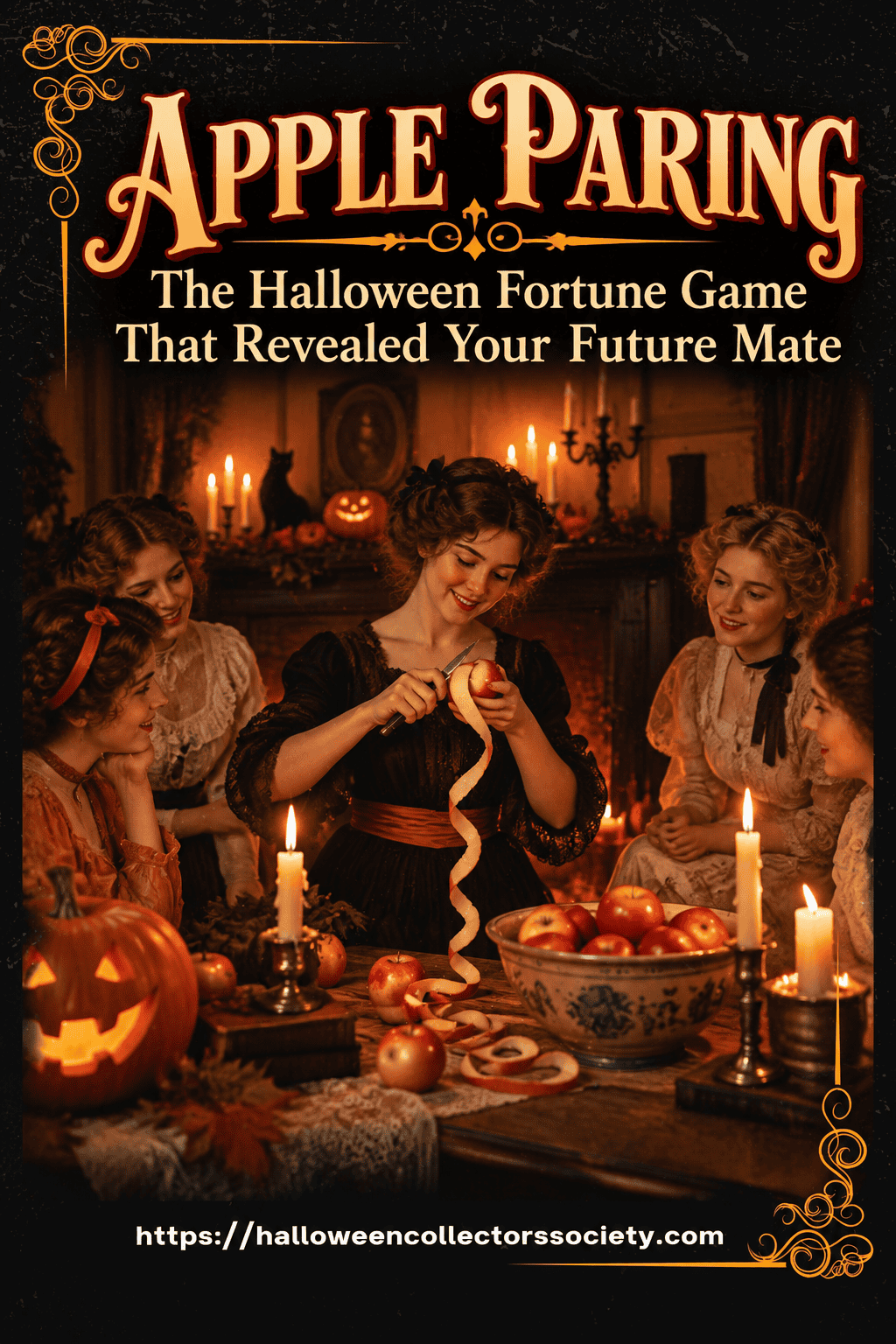
And then came the October 1898 Ladies' Home Journal. This one finally lets us see more of the room. Its "Apple-Paring Contest" gathers the guests around a blazing open fire. Two baskets of apples are brought in. Apples are set to roast on the hearth. Knives are handed around and everyone tries to pare an apple without breaking the peel.
The person who succeeds does not simply drop the paring and hope for the best. The participant stands in the middle of the room, swings the peel three times around the head from right to left and drops it over the left shoulder. Then everyone gets the payoff - what initial does that ridiculous curl of apple peel look like?
I love this account because suddenly Apple Paring has a fire, baskets of apples, roasting fruit, knives being passed around and people watching one another attempt the challenge. It feels like a party instead of an entry in a reference book. It also gives us another historical variation. The 1895 Harper's account says right shoulder. The 1898 contest says left shoulder. Later versions tell the player to swing the paring around the head and let it fall without specifying a shoulder at all. I am not going to clean that up and choose a "correct" shoulder for history. The disagreement is part of the history.
Then 1903 Gives the Game a Number
And there it is. In 1903, Hallowe'en Festivities, published in New York as part of Werner's Readings and Recitations, makes Apple Paring Game No. 30. After following the custom through all those earlier references, seeing it numbered like that feels almost funny. Somebody had taken an old love-divination idea and handed the hostess a set of party instructions.
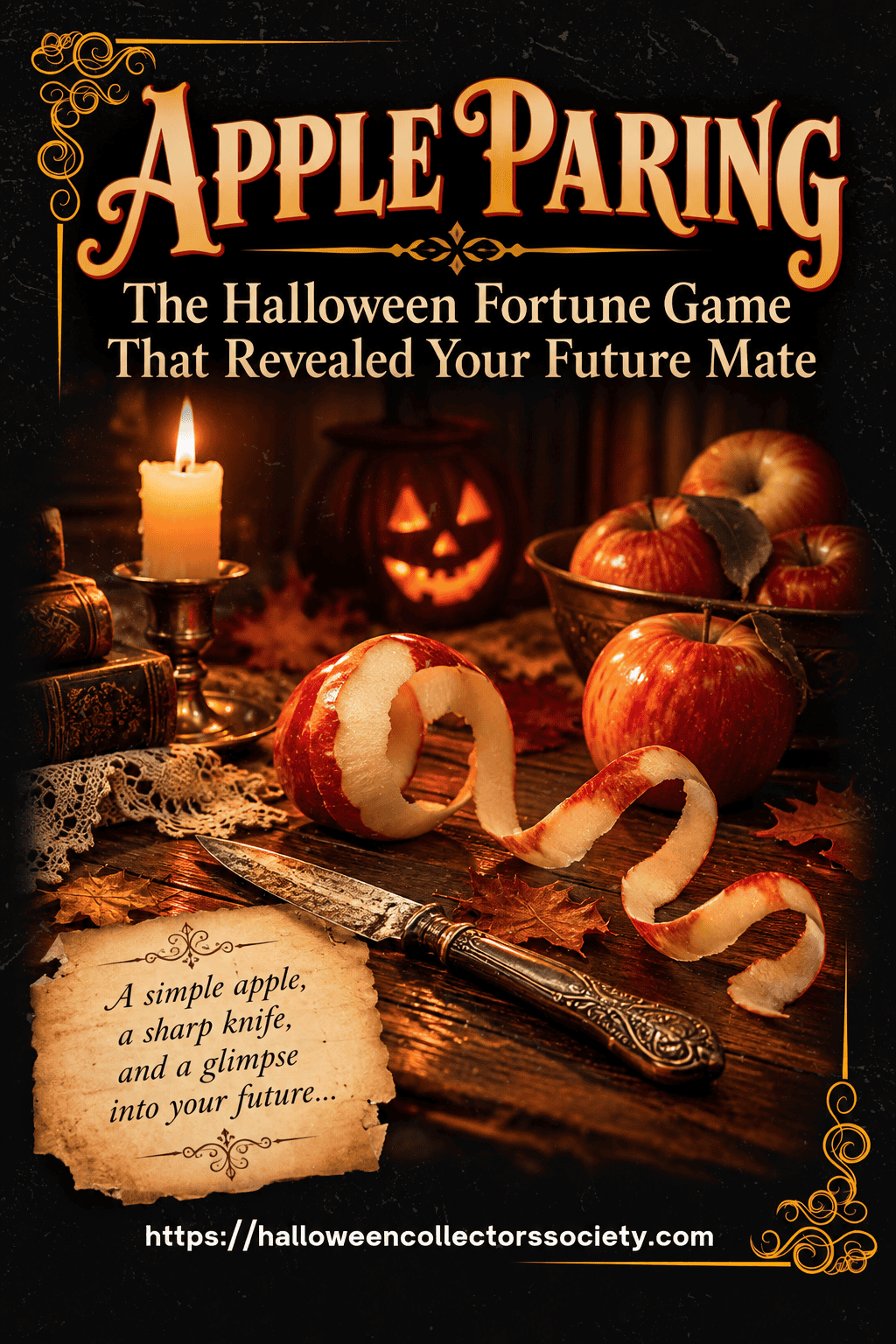
Each guest, receiving apple and knife, is requested to peel apple without breaking; then swing paring around head, and let it drop to floor. The letter formed is initial of future mate's name. Or, you may hang your paring over door - the first of opposite sex to pass under will be your mate.
Hallowe'en Festivities (1903), Game No. 30, p. 42
I have left that wording exactly as it appeared in the historical source. Yes, some of the grammar sounds strange to modern ears. That is part of the historical record, and I do not want to quietly rewrite the past to make it sound as though it were written today.
How Apple Paring Was Played
The challenge started before the fortune ever appeared. You had to peel the apple without breaking the paring. Anyone who has tried to remove an apple peel in one long strip knows that is easier said than done.
Once you had your long paring, you swung it around your head and let it fall to the floor. Then everyone looked at the shape it made and interpreted that shape as a letter of the alphabet.
That letter was the fortune.
If the peel looked like an M, for example, the historical rule did not give you an elaborate fortune about meeting a mysterious stranger beneath the moonlight. It simply said the letter was the initial of your future mate's name. That is important because when I began working on our digital recreation, it would have been very easy to add a collection of cute modern fortunes. I decided not to do that. The original game is charming enough without us pretending something modern was part of the historical tradition.
Imagine Actually Trying to Peel the Apple
This is one of those historical games that sounds ridiculously easy until you think about actually doing it. If you have ever peeled apples for pie, applesauce, apple butter or preserving, you already know where my mind went. That practical preserving side of apples is part of what I cover at Experimental Homesteader; here at HCS, we're following the apple into its old Halloween fortune-telling role. The instructions do not say to make a few pretty curls. You are supposed to peel the entire apple without breaking the paring.
That means one long continuous strip. Then, after all that careful peeling, you swing the entire apple peel around your head and let it fall on the floor.
I can picture the suspense - and the frustration when the peel breaks - without pretending a historical source described the room for us: everyone looking down at that curled peel and trying to decide what letter it resembles. Is that an M? A W if you stand on the other side? Maybe it is an S? The source gives us the rules. Our imaginations can supply the very human arguments that must have taken place when a floppy apple peel is expected to produce an alphabet letter.
That physical part is important to me because it is exactly what would be lost if we reduced Apple Paring to a modern button that simply spits out a random initial. The awkwardness and surprise is part of the game. You have to make the paring first, then you can play the game and find out the results. That is why our digital recreation makes the member go through the sequence instead of jumping straight to the fortune.
There Was Another Way to Play
The 1903 instructions also give an alternate version. Instead of tossing the paring, you could hang it over a doorway. The first person of the opposite sex to pass beneath it was supposed to be your future mate.
I can just imagine this happening at a Halloween party - and everyone suddenly becoming very interested in who was about to walk through that door.
But the bigger question is, how many times did the game accurately predict the player's future mate? I suppose that is a question we may never know the historical answer to.
Apple Paring Was Only One Fortune in a Much Bigger Halloween Night
One of the things I find most interesting about the 1903 Hallowe'en Festivities is what happens when you stop looking at Apple Paring by itself and look at the pages around it. Game No. 30 sits in a book of fortune-telling games and tests. Just before it are a True-Lover Test using hazelnuts, an Apple-Pip Test and a whirling Apples and Flour game. Immediately after it come the Four Saucers, Ring and Goblet, Apple Seeds, a necklace game and Cupid's Time.
The fortunes are overwhelmingly concerned with things people wondered about in their personal lives: love, marriage, whether a lover was faithful, when someone might marry, travel, wealth and what the future held. An apple seed might stand in for a lover. A ring suspended in a glass could supposedly spell a future mate's name. Four saucers containing dirt, water, a ring and a rag offered very different futures to a blindfolded guest.
And apples keep turning up. Elsewhere in the same 1903 book there is ducking for apples, a mirror-and-apple test, more apple-seed charms and other apple games. This was not a single oddball use of an apple that somehow wandered into a Halloween booklet. Apples were woven through the evening's games and divinations.
And then I reached the supper suggestions and the mashed potatoes stopped me cold. The book tells the hostess to hide a ring, thimble, key and dime in the mashed potatoes. Your bite of mashed potatoess could supposedly announce marriage, spinsterhood, money or a journey. I have read a lot of old recipes and old household instructions over the years, but I was not expecting matrimonial prophecy in mashed potatoes.
The rest of the table keeps right on going. The names alone can be confusing to us now, so I do not want to simply toss out Fortune Cake, Conundrum Nuts and Fortune Balls and move on as though everyone knows what they were. These were part of the entertainment.
Fortune Cake was cake with small fortune objects hidden inside. The 1903 book gives more than one version, including one using a heart, thimble, ring and even a dime. Elsewhere in the party instructions, finding the ring was supposed to mean marriage within the year. In other words, dessert could deliver your fortune right along with your bite of mashed potatoes.
Conundrum Nuts were something entirely different - and I love this idea. English walnuts were carefully opened, the nuts removed and little paper conundrums - riddles and wordplay - were rolled up and placed inside the empty shells. The halves were put back together and tied with small ribbons. Guests opened their walnuts and read the riddles aloud for everyone else to solve. These were not fortunes at all. The walnut shells turned the party into a guessing game, with each little shell holding something for the whole group to puzzle over.
Fortune Balls brought the fortune-telling back. These were popcorn balls formed around rolled paper fortunes. Each guest received one, found the paper hidden inside and was expected to stand and read the fortune aloud. The book says married guests could be given ordinary popcorn balls instead.
Then there were apples, chestnuts and Hallowe'en Pie, too. Imagine the whole evening together - games, fortunes, apples, nuts, cake, riddles tucked inside walnut shells, fortunes hidden in popcorn balls, stories and supper. Apple Paring makes more sense when we put it back into that world instead of isolating it as one strange old instruction.
Seen together, these details change Apple Paring for me. It was not simply a peel tossed onto a floor. It belonged to an evening in which the supper, the apples, the nuts, the fire and even ordinary household objects could become part of the amusement. That larger setting however is what makes the little game worth understanding.
By 1912, the Old Customs Were Being Collected
In 1912, Mary E. Blain published Games for Hallow-e'en, and Apple Paring was still there. The rules are familiar by now: keep the paring whole, swing it around the head, let it fall and read the letter as the initial of a future mate. She also preserves the doorway variation. What matters here is not that we need to hear the same rule one more time. Blain gives us another dated stop in the paper trail - evidence that the game was still considered recognizable Halloween entertainment nine years after the 1903 version we are recreating.
Blain's collection also shows how ordinary the materials of these Halloween games could be. A mirror and an apple became a test of whether a lover returned your affection. Chestnuts roasting before the fire could stand in for people and supposedly reveal whether they would draw together or separate. A wedding ring or key suspended inside a glass was used to spell a future mate's name. Even a lighted candle placed on the floor became a test: clear it in the jump and the coming year was promised to be happy; knock it over and the omen reversed. None of this required an elaborate manufactured game. The room, the hearth, the supper and things already at hand supplied much of the entertainment. Apples appear again and again, but in different roles - bobbed for, hung from strings, eaten before mirrors, cut open so the seeds could be counted, fixed to revolving games and, of course, pared into one long strip. The apple was not merely Halloween food in these collections. It became a remarkably adaptable prop for contests, courtship games and fortune tests.
The other 1912 source takes us somewhere different. In Christmas in Ritual and Tradition, Christian and Pagan, Clement A. Miles points to a Nottinghamshire Halloween custom in which apple parings were thrown over the left shoulder in divination. That regional reference matters because it is not simply another American party-book printing of Game No. 30. It shows the apple-paring idea living in a wider body of folk custom, with details that did not always match the published party-game rules exactly. Left shoulder, right shoulder, swung around the head, dropped to the floor - the surviving accounts vary, and those differences are part of the record rather than mistakes for us to tidy away.
Why Preserve Something This Simple?
Because simple things disappear.
A paper decoration can be saved in a box. A papier-mache jack-o'-lantern can sit on a collector's shelf for another hundred years if someone cares for it. A party game is different. The object is not the whole thing. The instructions, the gestures, the jokes, the anticipation and the reason people played it are part of what has to be preserved.
If all we save is an old illustration of a woman holding an apple, we have saved an image. If we save the documented instructions and the context around them, suddenly we understand what she might have been doing and why an apple peel on the floor could make an entire Halloween party lean in for a closer look.
This is exactly why I wanted to create the HCS Vintage Halloween Game Room.
Apple Paring does not require a game board, batteries, an app or a box full of game or puzzle pieces. The historical instructions take only a few sentences. It would be incredibly easy for a little amusement like this to become nothing more than a passing mention in an old digitized book.
But those little details tell us something about how people actually celebrated Halloween. They tell us what made people laugh, what questions fascinated them, what objects were already sitting around the house, and how much of the entertainment depended on the people gathered together as well as what they had on hand instead of something they bought.
That is worth preserving.
So We Recreated Apple Paring
Researching the game was only the beginning. I wanted HCS members to be able to experience it instead of simply reading about it.
So Apple Paring has become the first game in the Halloween Collectors Society Vintage Halloween Game Room. Our 2026 digital recreation lets you choose an apple, pare it, swing the paring, toss it and see what letter it forms. We kept the historical result authentic - the letter is the fortune. We did not add made-up predictions and pass them off as something people were told in 1903.
I also created a printable archival-style instruction sheet using the original 1903 wording. HCS members can print it and use it to recreate the physical game at their own Halloween gathering. The printable is clearly identified as an HCS 2026 archival presentation, not an original 1903 page or facsimile.
The digital game and printable instructions are included with the existing Halloween Collectors Society membership - there is no separate Game Room membership. HCS membership is $30 per year. Join the Halloween Collectors Society here and come try Apple Paring for yourself.
And this is only Game #1. I am deliberately taking these one at a time because I want the history researched and documented before we recreate anything. I would much rather preserve ten genuine Halloween games properly than fill a page with fifty modern games wearing vintage-looking graphics.
If you are already an HCS member, head into the Vintage Halloween Game Room and give Apple Paring a try. And if you actually recreate the physical version at a Halloween party, I would love to hear what letter your apple peel gives you.
Historical Sources
- Gay, John. The Shepherd's Week. 1714. Thursday; or, The Spell - apple-paring love divination involving Hobnelia and Lubberkin.
- Harper's Round Table. 1895. Halloween customs including apple paring and other apple amusements.
- Bergen, Fanny D. Current Superstitions. 1896. American Folk-Lore Society - whole apple-paring love divination recorded as "General in the United States."
- Ladies' Home Journal. October 1898. "The Apple-Paring Contest" - party instructions describing the fire, apples, peeling contest and left-shoulder toss.
- Hallowe'en Festivities. Werner's Readings and Recitations No. 31. Edgar S. Werner & Company, New York, 1903. Game No. 30, p. 42.
- Blain, Mary E. Games for Hallow-e'en. New York, 1912. "Apple Paring."
- Miles, Clement A. Christmas in Ritual and Tradition, Christian and Pagan. 1912. Discussion of Halloween apple and nut divination customs.
HCS Digital Adaptation: 2026
Preserve • Research • Share • Connect