Themed Halloween Collectible Displays: How to Showcase Your Vintage Collection
Themed Halloween collectible displays are one of the best ways to actually enjoy a serious collection instead of leaving wonderful pieces packed away in tubs and boxes. When you have collected Halloween for years, the problem usually is not finding enough to display. It is deciding what comes out, what stays safely packed away, and how to arrange very different pieces so they look like a collection instead of a Halloween store that exploded.
That becomes even more important when your collection includes antique and vintage Halloween. A German papier-mâché jack-o'-lantern, an old witch candy container, a stack of die-cuts, crepe-paper decorations, noisemakers and later plastic pieces may all belong in the same collection, but they do not necessarily belong in the same display.
Themed displays solve that problem. Instead of trying to display everything you own at once, pull together pieces that tell one visual story. The theme might be witches, black cats, jack-o'-lanterns, veggie people, haunted houses or simply the classic black-and-orange Halloween palette.
For serious collectors, there is another advantage: rotating displays lets you enjoy more of what you own without keeping every fragile piece exposed year-round. And if you own early paper, composition or papier-mâché Halloween, protecting the collection has to come before creating the perfect photograph.
Start With the Collection, Not the Decorations
Before buying display props, shop your own Halloween collection.
Open those tubs. Look through the boxes. Pull out pieces you have not seen lately. You may discover that you already have the beginnings of several very strong displays. If you are newer to the hobby, our Halloween collecting starter guide provides a broader introduction before you start arranging a collection by theme.
Try sorting potential display pieces loosely by subject, material, color, era, manufacturer or country of origin, object type, or simply by pieces that look wonderful together. Witches, cats, pumpkins, devils and ghosts can each become a theme. So can papier-mâché, composition, paper, tin or plastic. A shelf of lanterns tells a different story from a shelf of candy containers or noisemakers.
You do not have to make the display historically pure unless that is the point of the display. A German Halloween candy container can share a shelf with a later American noisemaker if the visual story works. On the other hand, an entire display of early German pieces can be spectacular precisely because the materials, colors and strange expressions belong together.
The important thing is knowing what you are doing rather than accidentally mixing pieces because they are all orange.
1. Build a Vintage Witch Display Around One Exceptional Piece
Witches give you an enormous amount to work with because they appear across so many forms of Halloween collectibles.
Instead of filling a shelf with every witch you own, choose one piece to command the display. That might be an early witch candy container, a witch lantern, a composition figure or an especially graphic witch die-cut. Documented antique Halloween collections include German composition witches, pulp witch candy containers, mechanical walking witches and pumpkin-headed witch lantern and candy-container forms.
That is the kind of object that does not need six modern props competing with it.
Give it room.
Place the primary witch slightly off center, then build outward with smaller pieces. A black-cat candy container, small jack-o'-lantern, witch noisemaker, postcard or paper decoration can carry the theme without competing with the focal piece.
If you own several witch pieces from different periods, another option is a small visual timeline. Start with the oldest or most fragile examples and progress toward later pieces. This lets visitors see how the Halloween witch changed rather than simply seeing a shelf full of witches.
Use Backdrops Without Endangering the Collection
Black fabric can work, but deep purple, faded orange, tobacco brown or dark green can sometimes make old Halloween colors look richer than pure black.
Old wooden boxes, shelves and cabinets can also provide atmosphere, but do not automatically put an antique Halloween piece directly against an unknown old surface. Use an inert barrier or archival material when necessary. Likewise, do not prop a delicate die-cut against a rough crate simply because the photograph looks good.
The display should adapt to the collectible. The collectible should never have to survive the display.
Light the Witch, Don't Cook Her
Use cool-running LED lighting rather than putting candles anywhere near antique paper or papier-mâché.
Actual flame has no business in a display of early Halloween collectibles.
Even though some original lanterns were designed around candles, surviving examples are collectibles now. We do not have to reenact every questionable decision made by Halloween celebrants a century ago.
2. Create a Classic Black-and-Orange Papier-Mâché Display
If there is one display that immediately says old Halloween, black and orange is hard to beat. This is where papier-mâché pumpkins and cats can shine. If you collect these early pumpkin forms, the history of paper pulp jack-o'-lanterns is worth knowing before you build the display around them.
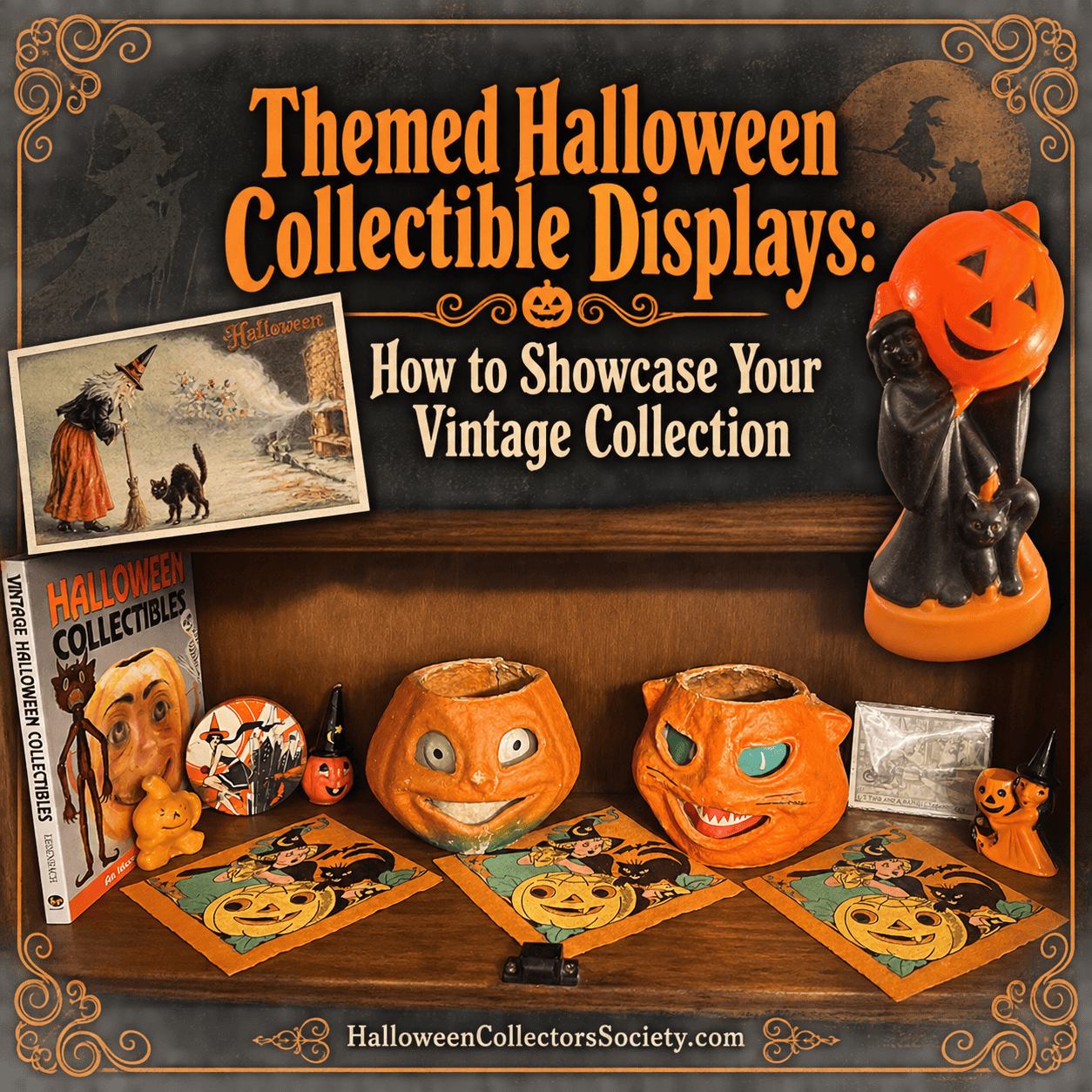
Rather than spreading them evenly across a shelf, cluster them. Put the largest jack-o'-lantern slightly toward the back, position a black cat to one side, then bring smaller pumpkins toward the front.
Odd numbers often make an arrangement feel less rigid, but a collector's display does not need to obey decorating rules if the objects themselves create a better composition.
And do not insist that every orange match. Old Halloween pieces often have wonderful variation-pumpkin orange, faded orange, yellow-orange, black, cream and the softer colors that come with age. Trying to force antique Halloween into a modern perfectly matched palette can strip away exactly what makes it interesting.
Bring In Original Paper Halloween
This is also the perfect place for vintage Halloween paper. Die-cuts can create height behind three-dimensional pieces. Vintage postcards can be displayed individually in appropriate protective holders. Noisemakers add shape and graphic interest.
And yes - crepe paper.
Vintage-style black-and-orange crepe paper can give the display movement and period flavor without pretending a newly purchased decoration is antique.
If you own actual early crepe-paper Halloween decorations, however, treat those as collectibles themselves rather than disposable display material. Do not tape them to the wall, pin them through the paper or wrap them around other objects.
There is a big difference between decorating an antique Halloween display with replaceable crepe paper and using antique crepe paper as though it were party-store bunting.
3. Create a Haunted-House Display Without Needing a Fake Haunted House
You do not need to buy a resin haunted house and make your antique Halloween collection orbit around it. The collectibles can create the haunted house.
Start with a black or very dark backdrop. Create several levels that suggest windows, attic spaces or rooms. Then place different Halloween inhabitants into those spaces.
A jack-o'-lantern can appear in one "window." A witch can occupy another. A black cat can lurk at ground level. A ghost or skeleton image can appear farther back.
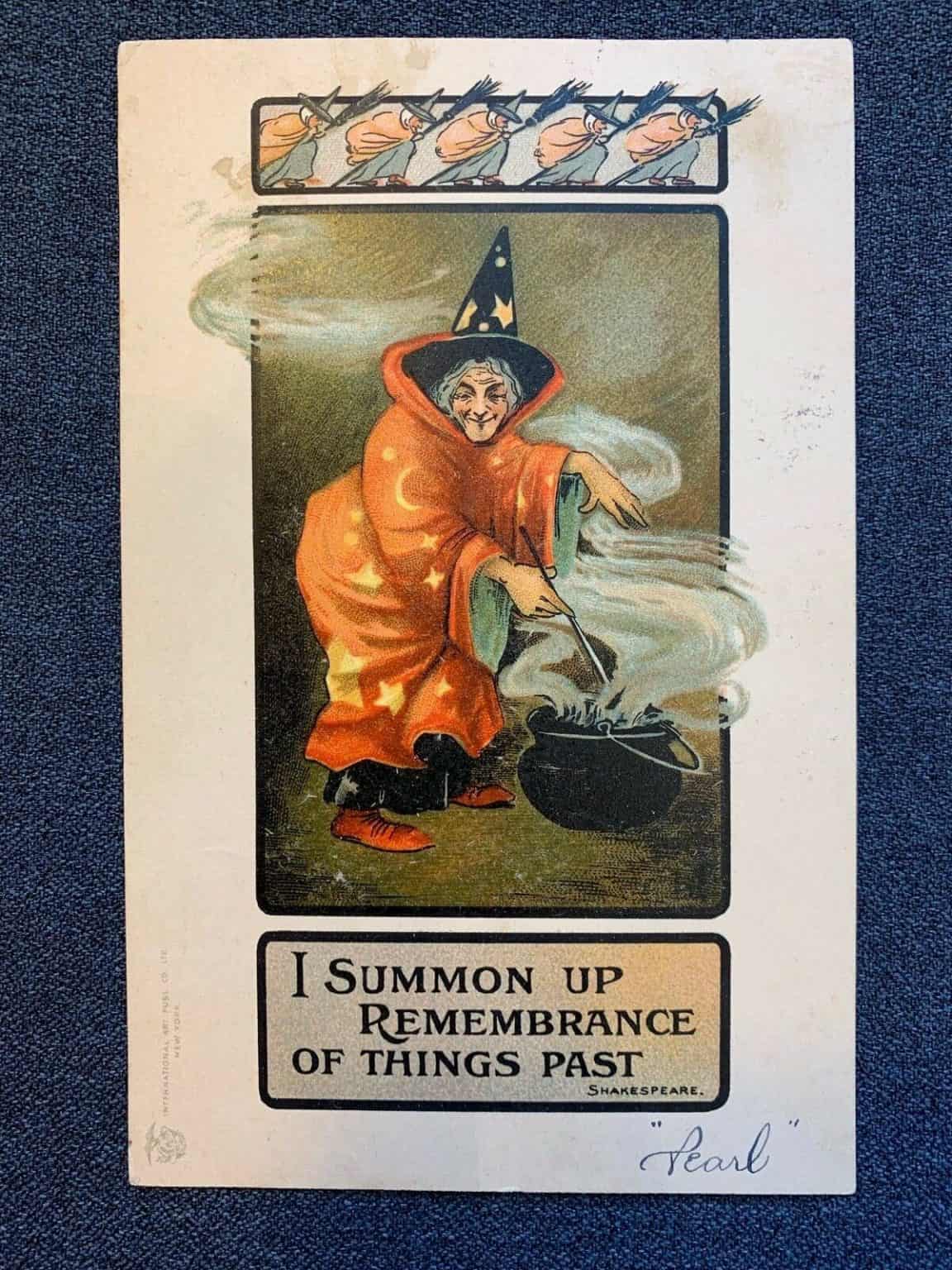
Paper Halloween is especially useful here because it can establish the scene while the dimensional collectibles become its inhabitants. A vintage Halloween postcard showing a house, moon, witch or nighttime scene can even become the visual inspiration for the entire arrangement.
Try a Cabinet of Halloween Curiosities
If you have a glass-front cabinet, secretary, apothecary-style cabinet or divided shelving unit, use the compartments as individual scenes.
One cubby can contain cats. One can hold pumpkins. Another can contain witches. Another can feature a single oddball piece that deserves attention.
Suddenly the entire cabinet becomes a haunted house without adding a single reproduction haunted house.
Skip the Fog Machine
I would not run a fog machine around valuable antique Halloween. Theatrical fog is unnecessary around fragile paper, paint, composition and papier-mâché, and added moisture or residue is not something I would intentionally introduce around a collection.
Dry ice is an even easier no. Cotton batting can snag delicate surfaces and fibers, too.
If you want fog, create the illusion of it. A smoky gray backdrop, translucent material positioned safely behind the objects, carefully placed LED lighting or even the shadows cast by the display can create atmosphere without exposing the collection to an effect machine.
With valuable Halloween, the safest special effect is usually the one that never touches the collectible.
Collector-Level Displays: Let One Rare Piece Lead
A serious Halloween display does not need to be built entirely from rarities. In fact, one exceptional piece often has more impact when the rest of the arrangement gives it context instead of trying to compete with it.
Think of the rare piece as the object that establishes the story. A scarce early lantern can be surrounded by more attainable postcards, paper decorations and noisemakers that repeat its colors or imagery. A spectacular witch can stand with a black cat, a jack-o'-lantern and period paper rather than five other expensive witches. This is especially useful when your collection has grown over decades and includes pieces at very different price points.
Collectors sometimes become so accustomed to their own collection that a remarkable object becomes just one more thing on the shelf. Deliberate spacing fixes that. Give the piece a little empty space. Raise it slightly if the support is stable. Place smaller objects lower and farther away. Make the eye arrive at the important object first.
Dream Pieces Worth Knowing Even If You Never Own One
One of the pleasures of collecting is knowing what is out there. Early Halloween makers produced forms far stranger and more ambitious than the familiar pumpkin bucket. Documented collections and major holiday auctions have included pumpkin-headed witch lantern and candy-container forms, mechanical witches, early cat lanterns, fur-covered black-cat candy containers and elaborate figural vegetable people.
These are useful in a display article because they show the collector what is possible without suggesting that every shelf needs a museum-level rarity. If your own witch display is built around a modest paper die-cut or postcard, knowing the more elaborate forms gives you historical context and may help you recognize something unusual when it turns up.
A Fortune-Telling and Halloween Party Display
Halloween collecting is not limited to decorations. Early party games and fortune-telling material can become a theme of their own. The documented Pick-A-Pumpkin Fortune Teller game is a wonderful example of the kind of object that can anchor such a display.
Build around the idea rather than filling the shelf with random pumpkins. Period postcards with fortune-telling imagery, party booklets, invitations, place cards and other genuine ephemera can support the story. If an original game retains loose components, display and store those components with particular care; completeness is part of what makes surviving party material so compelling.
This also gives you a way to display flat paper pieces that otherwise disappear behind large lanterns and containers.
Mechanical Halloween Deserves Its Own Space
Mechanical pieces bring another dimension to a collection, but age changes the rules. Documented early Halloween includes mechanical figures such as a witch and veggie man dancing toy and mechanical walking witches. A working mechanism is fascinating; it is not an invitation to demonstrate an antique over and over.
If you own mechanical Halloween, let the form and engineering be part of the display. Position it where the mechanism, base or unusual construction can be seen. If operation could cause wear, resist the urge to make the piece perform for every visitor. A hundred-year-old toy has already done its job.
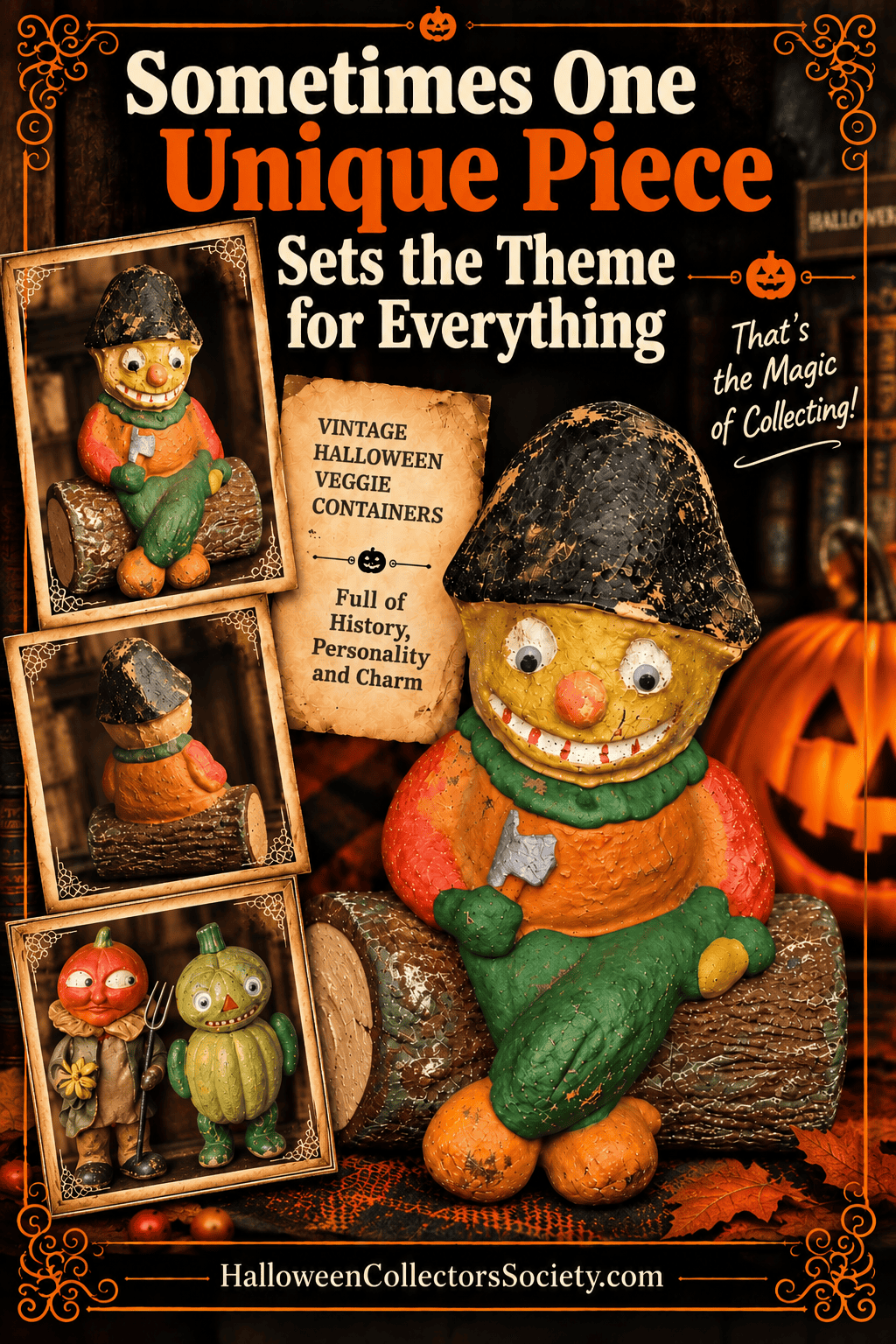
4. Let the Veggie People Out of the Box
Those wonderfully strange vegetable people deserve a display of their own. They are not simply "monsters," although some of them certainly look strange enough to join a monster display.
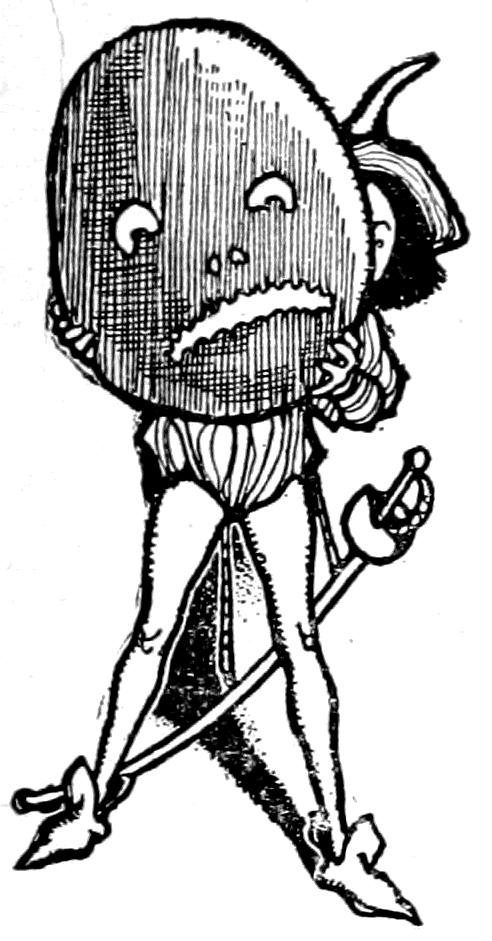
Early German Halloween candy containers include an astonishing assortment of anthropomorphic vegetable and fruit figures. Documented examples include vegetable men, pumpkin-headed figures, cauliflower-headed figures and other vegetable and fruit characters. There are also documented Veggie Man on Pumpkin forms and rare Lettuce Man pieces.
This is exactly the kind of material that makes hardcore Halloween collecting so much fun. It is weird, unmistakably old Halloween and much more interesting than filling a collector display with generic modern movie monsters.
The Vegetable People Get Much Stranger Than Pumpkins
This is a category where details matter because experienced collectors will know when somebody is simply inventing a cute name. Documented early pieces include male and female fruit and vegetable candy containers, a vegetable man with movable glass eyes and radish arms, a veggie man posed on a cucumber, an apple-head container with a moving or bobbing tongue, cauliflower-headed forms and figures that combine a vegetable character with a removable candle container.
There are also figural lantern and candy-container forms described in major collections as Pumpkin Vegetable Man, Veggie Man Ghost and Lettuce Man. One documented Lettuce Man was made as a lamp-form candy container with a candle holder and original facial inserts. These are not generic modern "monster vegetables." They belong to the wonderfully surreal vocabulary of early Halloween.
That distinction gives you a much stronger display. Instead of treating a veggie person as comic relief beside movie monsters, put it beside related early figural Halloween and let visitors see how bizarre the period material could be.
Make the Weirdness the Theme
If you have veggie people, do not hide them among twenty ordinary pumpkins. Give them their own display.
A group of vegetable-headed figures with a few jack-o'-lanterns can become an "Old Halloween Gets Weird" display. Keep the background relatively quiet. These pieces already have enormous visual personality.
A display label can identify the type, origin and approximate period when you know it. If you know provenance, include that too.
For a collector's home, small museum-style labels can actually make a display more interesting because guests stop seeing "old Halloween decorations" and begin understanding what they are looking at.
Rare Pieces Can Suggest an Entire Display Theme
Once you start looking at documented early Halloween, the categories get much broader than witches, cats and pumpkins. Morphy's 2010 Lowe collection, for example, included a foot-shaped lantern with a face and additional painted faces on all five toes, a veggie man posed on a cucumber, male and female fruit-and-vegetable candy containers, a veggie man with movable glass eyes and radish arms, a figure with a removable candle container on top of his head, and an apple-head candy container with a bobbing tongue.
You do not need to own any of those pieces to learn from them. They demonstrate how surreal early Halloween could be. If you own one oddball piece-a strange figural lantern, an unusual candy container, a nodder, a mechanical toy-do not bury it because it does not match your pumpkins. Let "strange early Halloween" be the theme.
A documented early Halloween felt Pumpkin Man offers another direction entirely. Rather than grouping by subject, a collector could build a display around unusual materials: felt beside papier-mâché, composition, paper and celluloid. That lets people see just how many different manufacturing traditions found their way into Halloween.
5. Build a Jack-O'-Lantern Study
Collectors with a lot of pumpkins can create something much more interesting than a row of orange faces.
Make it a study of the jack-o'-lantern.
Group examples by material, construction, facial expression, size or era. Papier-mâché lanterns can sit alongside candy containers and later plastic examples without pretending they are equivalent.
Look at the faces. Some are cheerful. Some are sinister. Some are goofy. Some are downright bizarre.
That is the collection.
Try arranging them from friendly to frightening, smallest to largest, or oldest to newest.
If you have examples with paper facial inserts, do not illuminate them with heat-producing bulbs. A small external LED can give the suggestion of a glowing lantern without modifying or stressing the original piece.
6. Create a Black Cat Display
Black cats are another theme capable of carrying an entire shelf. Vintage Halloween collections include cat-head lanterns, black-cat candy containers, die-cuts, postcards and other cat forms.
Cats also work beautifully with paper ephemera because their silhouettes are so strong. A three-dimensional cat in front of a framed or safely supported cat die-cut creates depth. Add one or two pumpkins rather than covering every empty inch.
The empty space matters.
A rare piece surrounded by twelve filler objects can disappear. The same piece with six inches of breathing room suddenly becomes important.
7. Make a Halloween Candy Container Display
Sometimes the object type itself is enough of a theme.
Candy containers are particularly good for this because early Halloween examples became wonderfully imaginative. Beyond pumpkins and witches, surviving examples include vegetable people, skulls, animals and other figural forms.
Arrange candy containers by size rather than lining them up by age. Put tall figures toward the back, mid-size examples to either side and smaller containers in front. If a piece opens in an interesting way, you can display it open only when doing so places no stress on the object.
Never repeatedly open a fragile antique container just to demonstrate to visitors that it opens.
We believe you.
8. Build Displays Around Era Without Making Them Look Like Museum Storage
If you have oodles of pre-1970 Halloween, era-based displays can finally give some of those tubs a reason to come downstairs.
Early Halloween
Bring together German papier-mâché, composition, candy containers, lanterns and early paper. Let materials and construction become part of the story.
1920s and 1930s Halloween
Paper decorations, lanterns, party goods, noisemakers and candy containers appropriate to the period can create a particularly graphic display.
Mid-Century Halloween
Later paper, hard plastic, masks, candy buckets and other postwar material can show how Halloween decorating and manufacturing changed.
1960s Halloween
Masks, candy buckets, party goods and other pieces can show the transition toward the Halloween many later collectors remember from childhood.
The exact boundaries should follow the pieces you actually own and can date-not an arbitrary internet checklist.
Use the Back, Middle and Front of the Shelf
A collector display needs depth just as much as it needs good objects. If everything sits in one straight line at the front edge of the shelf, even remarkable pieces begin to look like inventory.
Think in three layers. The back layer establishes height and atmosphere: safely supported paper pieces, framed ephemera, taller lanterns or a single large form. The middle layer carries the main story. The front layer is for smaller pieces that reward a closer look.
Do not create height by stacking fragile collectibles on other collectibles. Use stable risers hidden by the arrangement. A plain archival box, acrylic riser or well-supported platform is far less exciting than an old crate, but the viewer should be looking at the Halloween anyway.
Display the Details Collectors Care About
Sometimes the most interesting part of an object is not its face. Construction details, handles, paper inserts, seams, maker marks and unusual openings can be part of the story. If the bottom of a candy container has an important label or construction detail, photograph it and place the photograph or a small information card near the displayed object rather than repeatedly turning the antique upside down.
This is particularly useful for a collection that is also being documented. The display can show the beautiful side while your records preserve the underside, interior and condition details.
Damaged Halloween Still Deserves to Be Seen
A damaged collectible is not automatically a bad collectible. With early Halloween, survival itself can be remarkable. Paper tears. Facial inserts disappear. Handles detach. Papier-mâché gets crushed. Composition cracks. Crepe paper becomes brittle. Mechanical pieces stop moving. A piece can be incomplete and still be historically interesting, visually wonderful and worth displaying.
The first question is not "How do I hide the damage?" It is "What does this piece need in order to be safely supported?"
Turn the Best Side Forward - Without Pretending
If a papier-mâché pumpkin has one badly crushed side but a wonderful surviving face, there is nothing dishonest about displaying the face. Positioning is not restoration. The important distinction is that you are not altering the object or representing its condition inaccurately if you document or discuss it.
A missing back panel, damaged base or torn area can often be placed toward the rear while the object rests on a stable support. If damage affects structural stability, however, do not make the damaged area bear weight merely to get a prettier angle.
Use a Cradle Instead of Asking a Weak Piece to Stand
Some pieces should no longer support themselves the way they did when new. A weak candy container, crushed papier-mâché form or damaged lantern may benefit visually from a discreet custom cradle or stable inert support underneath it. The support should carry the weight without being glued, taped or permanently attached to the collectible.
Acrylic display stands can work for some objects, but "clear" does not automatically mean safe or stable. The stand needs to fit the object. A narrow pressure point under brittle paper is worse than a visible support that distributes weight properly.
Give Broken Paper a Safe Background
A torn die-cut can still be spectacular. Instead of taping the tear or forcing the original easel to work, display the piece against an appropriate archival backing or in a conservation-minded frame or holder. A dark backing can make losses less visually distracting while still leaving the actual object untouched.
For fragments, consider telling the truth proudly. A surviving section of an early decoration can be displayed as a fragment, especially when the artwork, maker information or construction is important. Not every survivor needs to masquerade as a complete example.
Missing Facial Inserts Can Become Part of the Story
Lanterns and figural pieces with missing or damaged paper facial inserts can look dramatically different from complete examples. Resist the temptation to improvise permanent replacements merely so the object looks better on the shelf. If you want viewers to understand what a complete example looked like, place a photograph or reference image beside the object rather than altering the original.
Do Not Make a Fragile Handle Carry the Weight
A surviving wire or paper handle can be visually important even when it is no longer trustworthy. Support the body of the lantern or container from below and let the handle rest naturally. Hanging a valuable piece from an original attachment point can turn a small weakness into a tear or loss.
Mechanical Does Not Have to Mean Working
A mechanical witch, nodder or wind-up toy does not lose its display value because you choose not to operate it. If the mechanism is stiff, unknown or fragile, display the object as an artifact. A small label explaining what the action originally did can communicate the magic without making century-old parts perform on command.
Use Damage to Teach
A damaged example can actually be one of the most educational objects in a collection. A split seam may reveal construction. A missing insert can show how the face was assembled. A worn bottom can expose a maker's mark or the way a candy container opened. Displaying a damaged piece beside a better-preserved example can show both the original appearance and the realities of survival.
That is collector nuance - not decorating around a flaw, but recognizing that condition and history are part of the object.
Do Not "Improve" Old Halloween for the Display
Faded paper, rubbed paint and small signs of age can be frustrating when you want a dramatic display, but the answer is not to make an old piece look new.
Do not repaint a worn face for the sake of the shelf. Do not glue a loose part because company is coming. Do not replace an old handle merely because a reproduction handle photographs better. And do not insert a hot bulb into a lantern to recreate the glow it had when new.
Display and conservation are different jobs. If a collectible needs repair, research the object and the appropriate conservation approach separately. A seasonal decorating deadline is a terrible reason to make a permanent alteration.
Protect the Collection While You Display It
This is where hardcore collecting and seasonal decorating part company.
You are not decorating with replaceable merchandise.
Old Halloween paper fades. Papier-mâché can be crushed. Composition can crack. Paint can flake. Adhesives and paper components age. Wire handles can stress fragile attachment points.
So before you put a valuable piece into a display, ask what is touching it, what is supporting it, how much light reaches it and what could fall onto it.
Avoid direct sunlight. Keep pieces away from heat sources and open flames. Do not use adhesive putty, tape or removable hooks directly on collectibles unless you know the material and product are safe for that specific object. Do not hang a valuable lantern by an old handle simply because that is how it was originally used.
And be particularly careful with risers.
An overturned vintage crate may look fantastic in a photograph. It is not fantastic when a four-figure papier-mâché candy container falls because somebody bumped the cabinet.
Use stable supports.
Paper Halloween Needs a Different Display Strategy
Postcards, die-cuts, party invitations, seals, place cards and other paper Halloween can disappear when they are treated as background filler. Give paper its own moment.
A small group of postcards can be stronger than covering an entire wall. Choose cards that repeat one subject-a witch at a cauldron, black cats, fortune telling, jack-o'-lanterns - or choose cards that show how one image changed over time. Appropriate sleeves or holders let you display them without tape, pins or pressure from heavier objects.
Large die-cuts can provide spectacular height, but support matters. Old paper can be brittle at edges, tabs and fold lines. If a die-cut has an original fold-out easel or hanging point, age may have made that original feature too fragile for regular use. "That is how it was made to hang" is not the same thing as "that is how this surviving example should be hung today."
Build a Display Around Material
Subject is not the only way to make a theme. A shelf devoted to papier-mâché tells a story about texture and construction. A paper-only display can show graphic design. Tin noisemakers create an entirely different visual rhythm. Postwar plastic can make a strong mid-century display without pretending to be earlier Halloween.
Material-based displays are especially useful when you have collected broadly. They allow a witch, cat, pumpkin and devil to coexist because the common thread is how they were made.
Use Reproductions as Supporting Cast - And Label Them
There is nothing wrong with using a reproduction, modern crepe paper or newly made display prop to finish a scene. The problem begins when the display blurs the line between old and new.
For a collector audience, clarity is part of the fun. If a modern reproduction is included because it provides height, color or a safe substitute for an impossibly fragile original, say so. That protects the historical integrity of the display and makes the genuine pieces more meaningful.
The same rule applies when sharing photographs online. A beautiful image can travel far beyond the original caption. When practical, identify reproductions so a future collector does not use your photograph as evidence that a modern piece is an undocumented antique.
Condition, Rarity and Display Value Are Three Different Things
Collectors know these ideas overlap, but they are not interchangeable. A mint common piece can be visually wonderful. A battered rarity can be historically important. A modest postcard can have more impact in a particular display than a much more expensive object that does not belong in the story.
Do not let price become the only hierarchy on the shelf. Put the piece that makes the display work where it needs to go.
Original Does Not Always Mean Untouched
Old Halloween has lived a life. Pieces may have old repairs, replaced components, writing, tape stains, faded areas or alterations made decades ago. Those details matter when identifying, valuing or selling an object, but a display article should not train collectors to erase them.
If an old repair is stable, it may simply be part of the object's history. If it is actively causing damage, that is a conservation question-not a cue to reach for modern glue.
Provenance Can Be Displayed Too
If you know where a piece came from, do not let that history live only in a spreadsheet. A discreet card can note a previous collection, family history, estate, old shop or other documented provenance. Keep the detailed paperwork safely stored elsewhere, but let the display acknowledge that the object had a story before it reached your shelf.
Keep the Identification Tentative When It Is Tentative
Hardcore collectors notice certainty that has not been earned. If you do not know the maker, do not assign one because the piece "looks like" another example. If the date is approximate, say circa or give a range. If a repair or replaced part is suspected, document the uncertainty.
The same discipline applies to display labels and online captions. "Early German papier-mâché candy container, maker unknown" is more useful than a confident attribution that cannot be supported.
You Don't Have to Display Everything
This may be the hardest part for a collector.
A collection does not become better because every piece is visible simultaneously.
If you own thirty black cats, display seven spectacular ones. If you have fifty jack-o'-lanterns, create a display of twelve whose faces look fantastic together. If your rarest witch looks lost in a crowded shelf, give her the shelf.
Then rotate.
One of the joys of having tubs and boxes full of Halloween is rediscovering them. A piece packed safely away for several years can feel almost new when it becomes the centerpiece of October's display.
Rotation also lets you tell different stories with the same collection.
Give the Rare Pieces Room to Be Rare
The most compelling Halloween collectible displays are not necessarily the biggest. Sometimes they are the smallest.
Imagine one exceptional early witch, a papier-mâché jack-o'-lantern and an original Halloween postcard against a dark backdrop.
Or three strange German veggie people standing together with nothing else competing for attention.
Or a row of old jack-o'-lantern faces illuminated from outside by a low, cool light.
Collectors spend years hunting for these things. Once we finally own them, they deserve better than being wedged between fifteen unrelated pieces because there happened to be an empty inch on the shelf.
The point of a themed display is not to make your collection look like a store.
It is to let you see your collection again.
Open a tub. Pull out a theme. Find the piece you have not really looked at in years.
Then build the display around the Halloween history you already own.
That is when a collection stops being boxes full of wonderful old things and becomes the reason we collected those wonderful old things in the first place.